
News
XXIII Brazilian Meeting of Ichthyology 2019, January
2019, October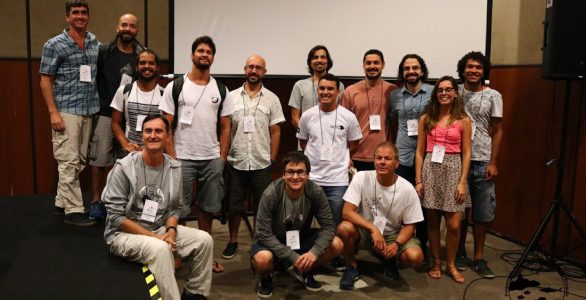
From 26th to 31st of January, the PELD – Oceanic Islands members attended the XXIII Brazilian Meeting of Ichthyology, held in Belém/PA. Different studies from the network were presented and discussed including topics such as temporal changes in populations climate changes affecting the coral composition and interspecies interaction. Dr. Sergio Floeter and Dr. Carlos Ferreira organized a Reef Fish Workshop with many presentations considering the reef environments of oceanic islands and the Brazilian coast. The event, which counted on about 1,200 people, was the ideal moment of discussion about the progress and national perspectives of ichthyological studies. The PELD members’ presentations were important to advance the understanding of how the temporal monitoring is increasingly needed, knowing that it gives us the opportunity to comprehend ecosystem processes at island with little human impact. Let the next results with more data about the Brazilian Oceanic Islands come!
Expedition Trindade and Martin Vaz Archipelago 2018, October
2019, October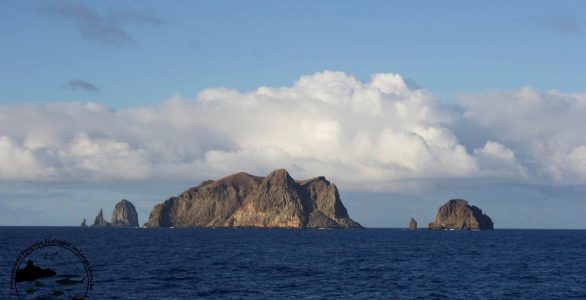

After a 64-days expedition on remote Ilha de Trindade (1,100 km east of Vitória / ES), Cesar Cordeiro and Linda Eggertsen members of LECAR with two UFSC researchers (Luisa Fagundes and Thais Macedo) returned to the continent. The expedition is part of the PELD-ILOC Project that carries out the ecological monitoring of the Brazilian oceanic islands. In addition, other activities of research associated with the project were carried out, including the collection of organisms and macroalgae that will be used in the bioprospecting of compounds of medical and pharmaceutical importance. Despite some difficulties were faced by the team due to bad sea conditions and technical problems, the expedition was concluded with a positive balance, counting on the support of the Brazilian Navy during the research activities on the island and in the transfer of the researchers.
Workshops: work group for fishing management in St. Peter and St. Paul’s Archipelago 2018, October
2019, October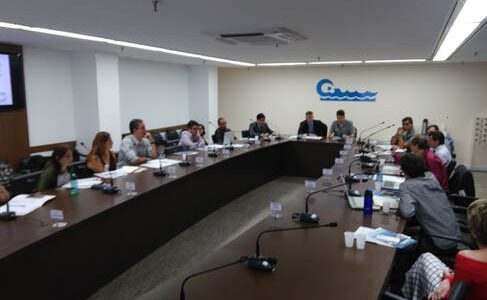
A second meeting of the workgroup for fishing management in St Peter and St Paul Archipelago took place last week at SECIRM in Brasília. The group gathered together sectors of the Brazilian Navy, the Mining and Energy Ministry (MME), the Chico Mendes Institute for biodiversity (ICMBio), the Brazilian Research Funding Agency (CNPq) and scientific researchers, including Ronaldo Francini-Filho and Carlos Ferreira from PELD-ILOC research network. The main topics discussed were the maintaining of pelagic fishing of tuna, wahoo and other pelagic species, while demersal reef fish is finally prohibited to catch. As long lines were banned in 2012, shark’s abundance increased in the region, indicated by ongoing telemetry and BRUVs sampling. Now, with demersal fishes protected, another important step towards the recovery of pristine ecosystems is made. The next meeting will happen already this year. Organized by ICMBio it will focus on the establishment of a manager-council and construction of management plan of the recently created protected area.
Expedition Fernando de Noronha Archipelago 2018, October
2019, October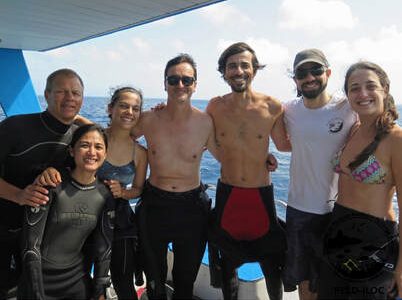
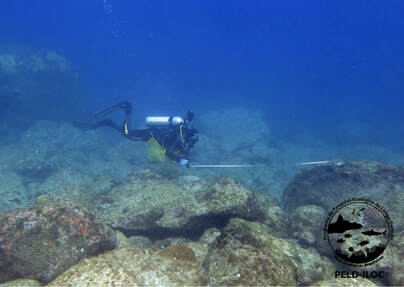
The sixth PELD ILOC (Long-Term Monitoring of the Brazilian Oceanic Islands) expedition to Fernando de Noronha Archipelago took place between October 20th and 31st, 2018 and was attended by the researchers Carlos Eduardo Leite Ferreira (UFF/LECAR), Sergio Floeter (UFSC/LBMM), Julia Biscaia Zamoner (UFSC/LABAR), Mariana Teschima (UFRJ), Ronaldo Bastos Francini-Filho (UFPB), Guilherme Ortigara Longo (UFRN/LECOM) and Thayná Mello (ICMBio-Fernando de Noronha). During the 12 days at the archipelago, which is located 200 miles from Brazilian northeast coast, the researchers carried out activities related to the annual monitoring of reef fish assemblage (visual censuses), benthic community structure(photo-quadrats), health status of Siderastrea and Montastraea colonies (photo-quadrats and, for Siderastrea, filming for 3D modelling) and population structure of Grapsus grapsus, besides the setup of seawater temperature sensors. Activities of other researchers associated to the project were also developed, such as the collection of corals for studies of zooxanthellae – microalgae that inhabit the colonies, providing them food and being responsible for their different colours -, as well as the placing of information signs for the De Olho Nos Corais project. The good weather and sea conditions, the excellent teamwork and support of ICMBio and diver operators resulted in a successful expedition, full of hard work, discussions and learning! Natural beauties, both into and out of the water, as always, made the expedition even more incredible! We’re just ready for the next one!
Expedition St. Peter and St. Paul’s Archipelago 2018, September
2019, October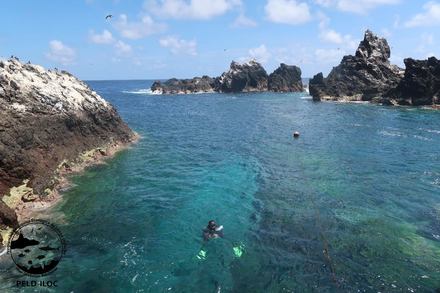
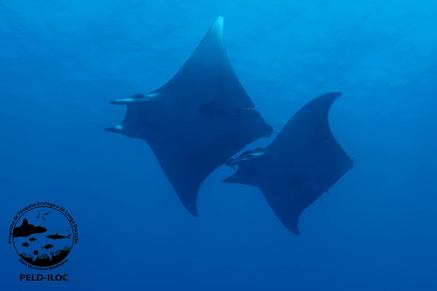
The expedition to ASPSP that occurred between September 16 and 30, the team was composed by Larissa (UFAL), Thayna (ICMBio), Caio (UFES) and Moysés (UFF). The arrival happened on the night of 16/9 after 100 hours of sea. Some problems due to weather conditions prevented the actions of the PELD in the last two days, however, the expedition was completed positive balance and a relevant number of samples collected and monitoring images. A total of 80 dives were performed to improve the sampling. The ASPSP monitoring included 40 visual fish censuses, 33 plots videos of three different depths, 9 fixed benthic transects, G. grapsus census, algae collections, dinoflagellates and 20 BRUVs. The fixed transects were changed and the thermometers of the different depths were also changed. This expedition was supported by Guilherme Longo and Zélia Brito.
Expedition Rocas Atoll May/June, 2018
2019, September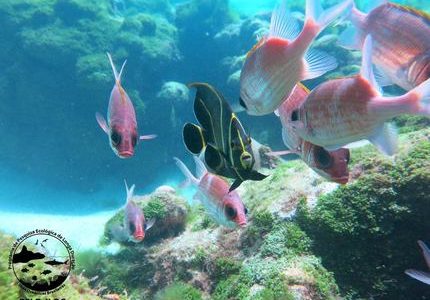
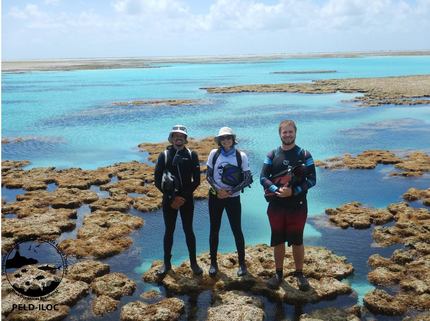
During May and June, three researchers of PELD-ILOC conducted extensive data collection on Rocas Atoll, one of the Brazilian oceanic islands monitored by the initiative. The team was formed by Dr. Vinicius Giglio (UFF), Dr. Katia Capel (URFJ), M.Sc. candidate Vitor Picolloto (UFSC), and the reserve assistance was provided by Jarian Dantas (ICMBio). The main objective of this expedition was to perform the annual monitoring of reef components, and the activities included underwater visual censuses to assess reef fish assemblages, photoquadrats for the benthic community and sampling of the crab Grapsus grapsus.
Researchers observed relatively high abundances of reef fish, mainly mesopredators such as the dog snapper Lutjanus jocu, lemon shark Negaprion brevirostris and the nurse shark Gynglimostoma cyrratum. These are clear indications of the effectiveness of the marine protected area.
Importance of Aratu crab (Grapsus grapsus) in St. Peter and St. Paul’s Archipelago
2019, September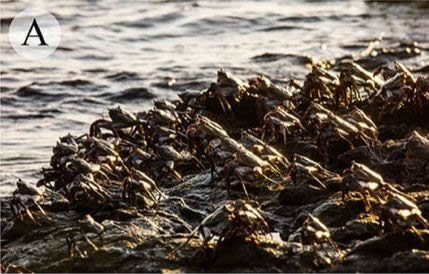
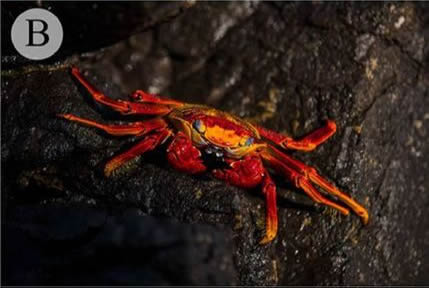
In a place of intense endemism and low diversity of species, the Aratu Crab (Grapsus grapsus) plays a key role in the reef environment, strongly acting as a connection between the intertidal and subtidal reef environment. Considering that in the western South Atlantic G. grapsus occurs only in the Brazilian oceanic islands and that the ASPSP population is maintained by self-recruitment, without considerable dispersion of the species, long-term monitoring of the Aratu Crab populations is justified, not only because of its direct influence on the reef pelagic system, but also because it signals the environmental conditions of adjacent rocky shores. When assessing the results of the ASPSP monitoring over the last few years, performed by counting G. grapsus at 10 transects and by subsequent analysis of the structure of 100 individuals, there is a tendency of a decreasing abundance of crabs, a decreasing size of ovigerous females and an increasing proportion of mutilated organisms over time. Therefore, there is a need for a longer period of monitoring, since if the trend of these parameters is confirmed, a change in the environmental factors of the archipelago and a decrease in the fecundity rate and supply of larvae to the reef environment are revealed. The whole article is available in the book chapter “Temporal Variation of the Preserved Communities in the São Pedro and São Paulo Archipelago: Actions of the Long-Term Monitoring Project (PELD/ILOC).
St. Peter and St. Paul’s Archipelago reef fish assemblage
2019, September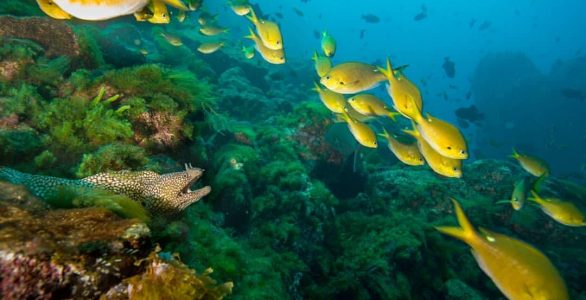
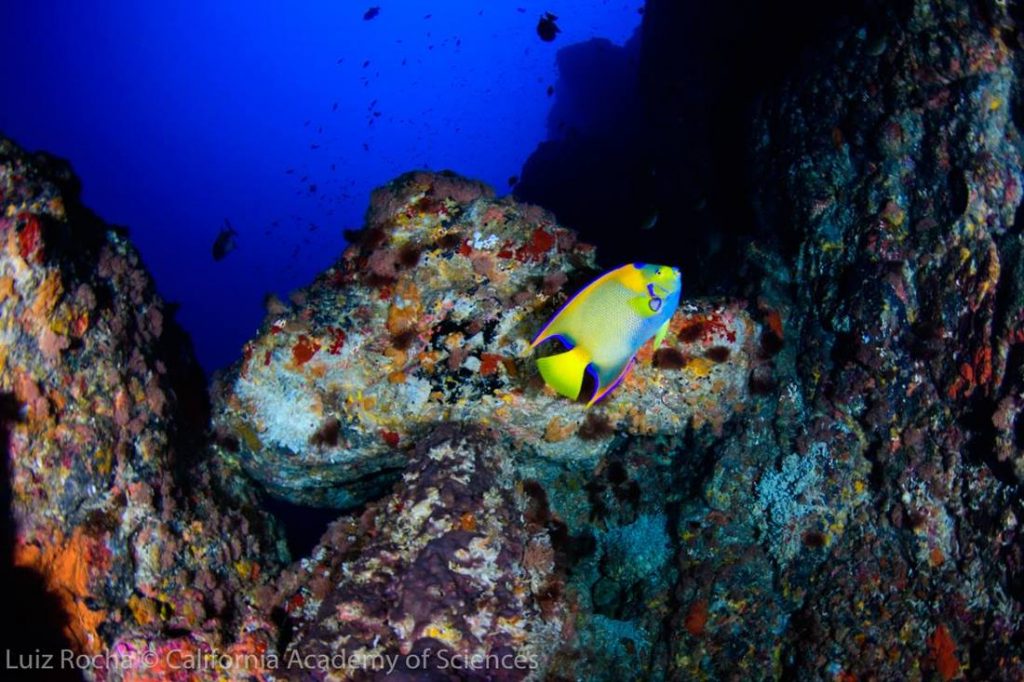
The archipelago of St. Peter and St. Paul’s is a set of Brazilian oceanic islands farther from the coast. It is a place well preserved and, thus, of particular importance for marine biodiversity. In St. Peter and St. Paul’s Archipelago the PELD-ILOC aims to carry out monitoring of this biodiversity, especially of the ichtyofauna, providing important information which show more and more the specialty of this place. St. Peter and St. Paul’s Archipelago has the lowest diversity of fishes in the South Atlantic, but, however, a high rate of endemism. We find species with different morphologies and different color patterns that do not occur in other islands of the Atlantic. Until a depth of 50 m, the St. Peter and St. Paul’s Archipelago reefs are well known compared to other Atlantic Islands. Recent expeditions have investigated the mesophotous fish, that occurs between 30 and 90 meters depth, a hitherto little described habitat. Since 2013, the monitoring of the ichthyofauna has been performed annually. It was observed that about 90% of the fish analyzed in the first year, were again observed in the following years. In these years, there were events of fish biomass and density being related to the large number of species. The species size has increased little during the years with carnivorous species increasing especially in the first years decreasing to their average size within the last two years. Furthermore, there was no shark species recorded during any expeditions. This article is available in the book chapter “Temporal Variation of the Preserved Communities in the St. Peter and St. Paul’s Archipelago: Actions of the Long-Term Monitoring Project (PELD-ILOC), see also “Publications”.
- « Previous
- 1
- 2
- 3